Signs Your Garage Floor Needs Coating
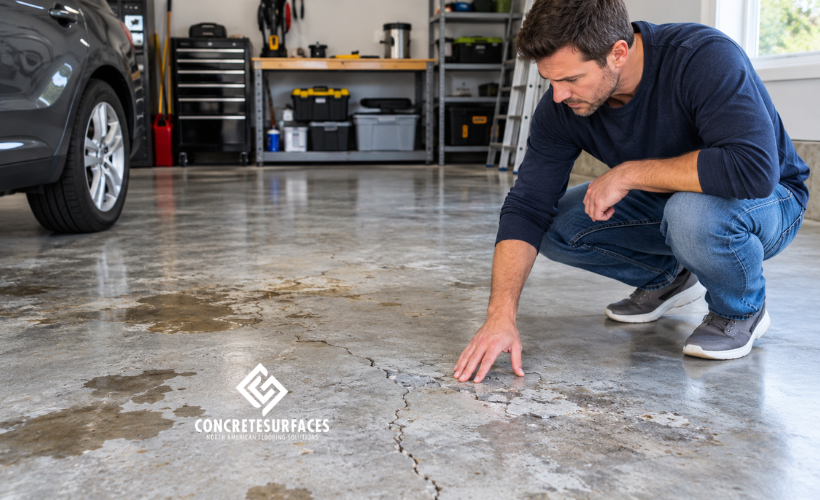
Garage Floor Coatings protect concrete from the wear that vehicles, road salt, and dropped tools create every day. A bare concrete floor seems solid. Concrete is porous, though, so it soaks up whatever lands on it. Most homeowners in Cambridge, Zanesville, and New Philadelphia wait until the garage floor looks bad before calling anyone. The signs that your garage floor has stopped protecting itself show up months earlier. American Concrete Surfaces has installed resin flooring across central and eastern Ohio for 25 years, and the same symptoms turn up on nearly every inspection.
5 Signs Your Garage Floor Needs a New Coating
An installer can read most of a garage floor in one walk across it. Five signs come up again and again. Each of these five clear signs means the concrete needs protection, and together they are the signs it’s time for a new floor coating:
- Cracks and pits: hairline lines, flaking edges, or broken chunks mean the concrete slab is coming apart.
- Stains that stay: oil, grease, salt, and every spill soak in and will not wash out.
- Constant dust: gray powder stirred up by foot traffic means the top layer is wearing away.
- Peeling garage floor paint: paint or sealer that bubbles and flakes is no longer protecting anything.
- Slick, thirsty surface: if the garage floor feels slippery when wet or drinks water on contact, no barrier is left.
Cracks, Pits, and Flaking Edges
Hairline cracks are the first structural warning. They start near the grooves cut into the slab, or along the door threshold, then widen as water gets in and freezes. Concrete expands and contracts with every temperature swing. Water trapped inside a crack expands as it turns to ice and pries the slab apart from within. Each Ohio winter opens the gap a little wider.
Chipping comes next. Installers call it spalling: the top layer separates and breaks off in flat pieces, leaving shallow pits with the stone underneath exposed. Road salt speeds this up. Brine drips off vehicles and soaks into the concrete substrate, where it works on the surface all winter. Once chunks break loose near the door, the damage is no longer cosmetic.
Small cracks are still fixable. A professional concrete installer grinds the slab, fills the cracks with a rigid patch, then bonds a coating across the repair so the whole surface acts as one piece. Wait too long and a simple patch turns into partial slab replacement.
Cracks That Point to a Deeper Problem
Some cracks mean the ground under the slab is moving, not that the surface is wearing out. Watch for cracks wider than a quarter inch, cracks where one side sits higher than the other, and cracks that open again after a repair. Those usually trace back to settling soil and need checking first, because no coating can bridge a slab that is still shifting.
Stains That No Longer Wash Out
Concrete naturally absorbs liquid the way an unglazed brick does. Motor oil, transmission fluid, antifreeze, and battery acid sink below the surface in minutes. A degreaser pulls some of the color back out, but the stain returns as moisture carries the residue up again.
Chemical damage goes deeper than the stain. Battery acid and salt brine attack the cement paste that holds the stone together, which leaves the top layer soft and crumbly. An epoxy coating seals the surface completely. The next spill sits on top instead of soaking in, and the entire garage becomes easier to clean.
A Fine Layer of Dust on Everything
Run a hand across a bare slab and look for gray powder. That powder is called laitance, and it means weak cement particles are working loose. The dust lands on toolboxes and vehicle hoods, tracks into the house, and ends up in the furnace filter.
Dusting means the floor is shedding material right now. A sealer slows it for a season. A concrete coating bonds into properly prepared concrete instead, so the installer grinds the weak layer off first, then locks down the solid surface underneath.
Peeling Paint and Failed Coating Kits
Store-bought floor paint and DIY epoxy kits fail in a predictable way, and a peeling floor is the clearest sign the slab needs professional installation. These products go on over a light acid wash, or over a swept floor with no preparation at all. Nothing has roughened the concrete, so the film sits on top rather than gripping it.
Hot tire pickup finishes the job. Warm tires soften a thin surface film where they sit, then peel it up in sheets when the car pulls out. Once bubbling or ring-shaped marks appear in the parking spot, the old film has to be ground off before anything new goes down. A professional epoxy floor coating starts with that grinding, which is the reason it stays put.
Water Absorption and Slick Spots
Pour a cup of water on the slab and watch. If the concrete darkens and the water vanishes within a minute, you have porous concrete with nothing sealing it. That water freezes in winter and pushes the surface apart from the inside.
A white chalky film in the same spots is efflorescence, which is salt carried up to the surface by moisture rising through the slab. A coating put down over rising moisture will bubble and lift, so testing early is how you protect your concrete before installation starts. A floor that turns slick under wet tires needs a non-slip finish as well, which installers create by scattering fine grit into the top coat.
Test for Moisture Before a New Garage Floor Coating
This test costs nothing and prevents an expensive failure:
- Tape an 18-inch square of clear plastic sheeting flat to the concrete, sealing all four edges.
- Leave it alone for 16 to 24 hours.
- Lift it up. Beads of water underneath, or a dark patch on the slab, mean moisture is rising through the concrete.
- Repeat near the door and along exterior walls.
A positive result does not rule out a coating. It tells the installer to use a primer built to handle moisture. American Concrete Surfaces runs this test during every assessment.
Why Ohio Garages Age Faster
Guernsey County goes through roughly 100 freeze and thaw cycles a year, and road crews salt heavily from November through March. Cars carry that brine home and drip it on the slab overnight. Summer humidity then pushes moisture up from the soil below. The combination produces signs of wear far faster than the same floor would show in a dry climate.
Choosing the Best Garage Floor Coating
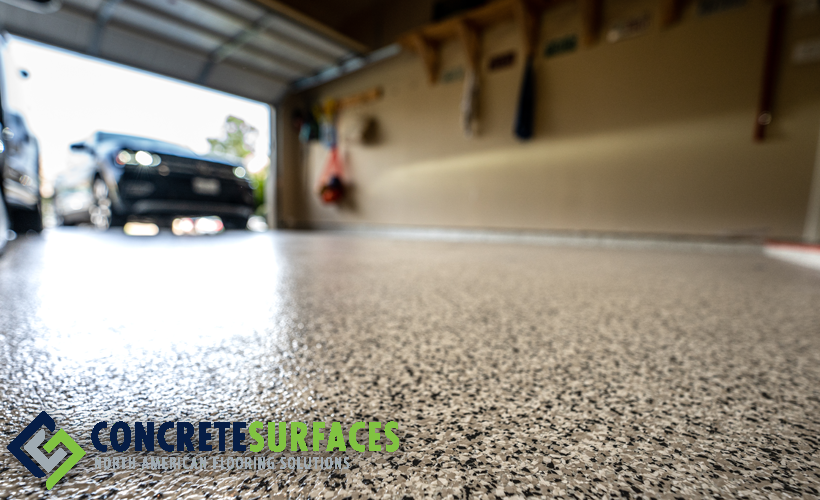
Garage Floor Coatings do more than change the color of the slab. American Concrete Surfaces matches the proper coating system to how you actually use the space:
- Epoxy floor systems: epoxy provides a thick build and a strong bond, which makes an epoxy garage floor a long-lasting choice for a standard home garage.
- Polyaspartic coating and polyurea coating: both cure in hours, hold up to UV without yellowing, and stay flexible near an open door.
- Urethane and MMA: chemical resistance and impact strength for workshops and equipment bays.
- Polished concrete: a dense, low-maintenance flooring solution that uses the slab you already have.
A polyaspartic floor is stronger than epoxy against impact and temperature swings, so polyaspartic garage floor coatings fit garages with wide doors and hard winter use. The best coating depends on your budget and your daily traffic. A professional coating system bonds into the slab instead of sitting on top of it. Every professional garage floor coating goes down over a ground surface, with cracks filled and moisture handled first, and a professionally installed floor lasts for decades rather than seasons.
Book a Floor Assessment Today
A garage floor never fails all at once. It cracks, dusts, stains, and peels in stages, and each stage costs more to fix than the one before. If your garage floor needs a professional opinion, booking one now protects the concrete that is still sound. The right coating creates a sealed surface that cleans with a mop and leaves a floor that looks finished. American Concrete Surfaces serves homeowners in Newark, Dover, Coshocton, and Cambridge with on-site assessments and straight answers.

Call (740) 260-1122 to protect your garage floor with Garage Floor Coatings built for eastern Ohio.
The post Signs Your Garage Floor Needs Coating appeared first on American Concrete Surfaces.
from American Concrete Surfaces https://americanconcretesurfaces.com/signs-your-garage-floor-needs-coating/
via American Concrete Surfaces


Comments
Post a Comment